Numerology Bridge Numbers: Calculate Both Pairs, Including Zero
2026-11-20 · 10 min
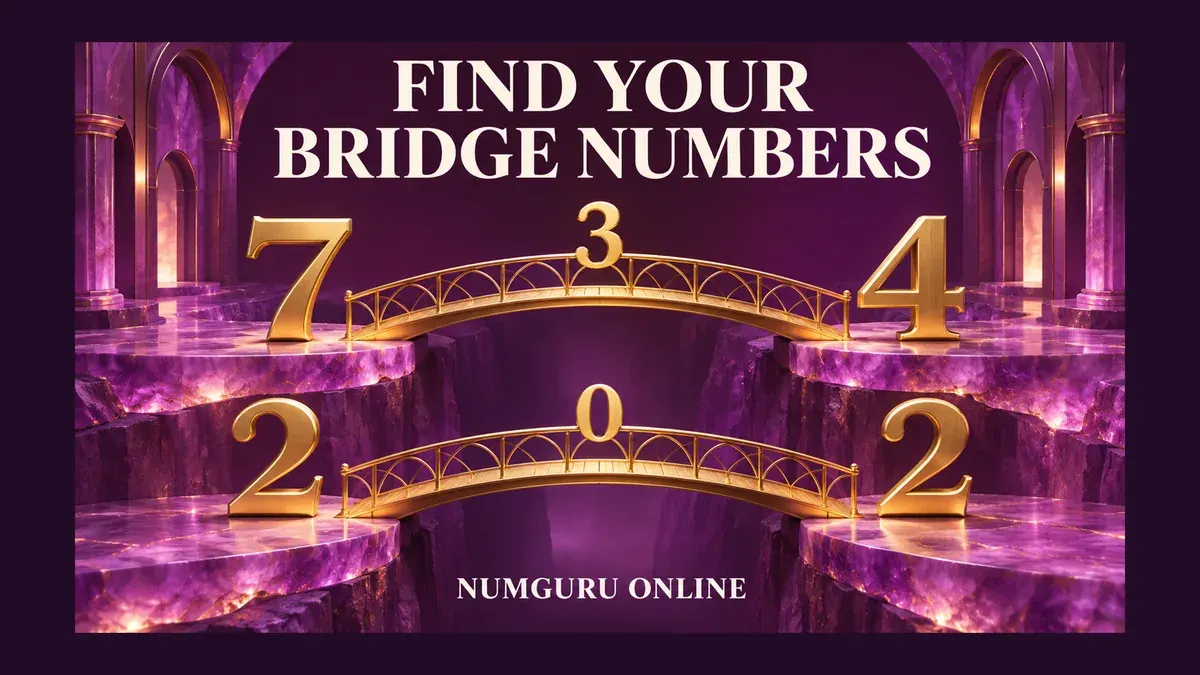
Calculate two Bridge Numbers from one numerology chart
A numerology Bridge Number is the nonnegative difference between two specified chart numbers after reducing each to a single digit. Two common pairs are Life Path with Expression, and Heart's Desire with Personality. For example, Life Path 7 and Expression 4 give a Bridge of 3. Equal inputs give zero: 2 minus 2 equals 0.
The pair matters as much as the answer. A 3 between Life Path and Expression compares different positions from a 3 between Heart's Desire and Personality. Keep both labels beside the subtraction. This guide builds both results from original fictional examples, shows what happens to master numbers and explains how to use the result without turning it into a score.
Numerology is a belief and symbolic reflection practice, not an established scientific test of personality or a proven way to predict events. The calculations below can be checked objectively. The personal meanings attached to them remain interpretations that you can question or decline.
Which two numbers belong in each pair?
The Life Path–Expression Bridge combines a birth-date result with a name result. The Heart's Desire–Personality Bridge compares two groups within the same name. Heart's Desire is also called Soul Urge; Expression is sometimes called Destiny. Check the inputs behind those labels because terminology varies across systems.
- Life Path: calculated from the complete birth date.
- Expression: calculated from all mapped letters in the chosen full birth name.
- Heart's Desire: calculated from that name's vowels.
- Personality: calculated from that name's consonants.
The Numerology.com core-number overview describes these four underlying positions. Here we use them only as inputs. For broader context before subtracting, our Life Path and Destiny comparison explains the distinction between the date and name calculations.
These are two commonly documented bridges, not a claim that every report contains exactly two. Hans Decoz's sample personality profile includes both and also labels a Life Path–Birth Day Bridge. Read the complete pair name whenever a report presents an additional bridge.
Use single-digit inputs before subtracting
For this worksheet, reduce each input repeatedly until it lies between 1 and 9. That includes master-number inputs: 11 becomes 2, 22 becomes 4, and 33 becomes 6. Then subtract the smaller single digit from the larger. The result lies between 0 and 8, inclusive.
Life Path–Expression Bridge = absolute difference between their single-digit values. Repeat the same operation with the single-digit Heart's Desire and Personality values for the other Bridge. Absolute difference simply means the distance between the two values, regardless of which appears first.
The RoxyAPI numerology reference explicitly documents single-digit master-number reduction before Bridge subtraction. Decoz's sample provides a useful cross-check: it lists Heart's Desire 22 and Personality 13/4 with a Bridge of 0. Their single-digit inputs are both 4. Subtracting the displayed compounds directly would produce a different result.
Keep your original core result in one column and the Bridge input in another. Recording 11/2 in the Life Path column and 2 in its Bridge-input column preserves the original label while showing the operation you actually performed. Reducing a value for this calculation does not require rewriting every other position in your saved chart.
Example one: Lena Cole has two Bridges of 3
Our first fictional person is Lena Cole, born March 14, 1988, with no middle name. Use the repeating Pythagorean A–Z mapping, add all letters before reducing the full-name total, and classify A, E, I, O and U as vowels. There is no Y or transliteration decision in this example.
For Life Path, this exercise adds all date digits before reducing: 3 + 1 + 4 + 1 + 9 + 8 + 8 = 34. Then 3 + 4 = 7. A component-first check also ends at 7 for this date: month 3, day 14 becomes 5, and year 1988 becomes 26, then 8; 3 + 5 + 8 = 16, then 7.
Now calculate the full name. LENA gives L = 3, E = 5, N = 5 and A = 1, totaling 14. COLE gives C = 3, O = 6, L = 3 and E = 5, totaling 17. Expression is therefore 14 + 17 = 31, reduced to 4.
The vowels are E, A, O and E. Their values total 5 + 1 + 6 + 5 = 17, reduced to 8. The consonants are L, N, C and L. Their values total 3 + 5 + 3 + 3 = 14, reduced to 5. Check that 17 + 14 = 31, matching the complete name total.
With the four inputs ready, the two final lines are:
- Life Path–Expression: 7 minus 4 = 3.
- Heart's Desire–Personality: 8 minus 5 = 3.
The repeated 3 does not make these duplicate calculations. The first came from a date result and an all-letter name result. The second came from a vowel result and a consonant result. Neither tells us what Lena actually thinks or does; she is an invented person used to make the arithmetic inspectable.
If you want to reproduce the mapping independently, keep our Pythagorean alphabet chart beside the worksheet. Check repeated letters as separate occurrences. The two Ls and two Es in Lena Cole each contribute twice across the full name.
Example two: Noah Bell combines master inputs and zero
Our second fictional person is Noah Bell, born March 6, 2000, again with no middle name. Keep the same alphabet and vowel rules. For the core calculations in this example, retain 11, 22 or 33 when reached during reduction; for the later Bridge step, reduce those retained labels to single digits.
The birth-date digit total is 3 + 6 + 2 + 0 + 0 + 0 = 11. That gives a core Life Path label of 11/2. Its Bridge input is 2. Notice that the zeros have been included transparently, although adding them does not change the sum.
NOAH contributes N = 5, O = 6, A = 1 and H = 8, totaling 20. BELL contributes B = 2, E = 5, L = 3 and L = 3, totaling 13. The Expression total is 20 + 13 = 33, retained as 33/6 in the core column and converted to 6 in the Bridge-input column.
The vowels O, A and E give 6 + 1 + 5 = 12, reduced to 3. The consonants N, H, B, L and L give 5 + 8 + 2 + 3 + 3 = 21, also reduced to 3. Their raw totals reconcile: 12 + 21 = 33.
- Life Path–Expression: single-digit inputs 2 and 6; 6 minus 2 = 4.
- Heart's Desire–Personality: single-digit inputs 3 and 3; 3 minus 3 = 0.
Subtracting 11 from 33 would give 22, which is valid ordinary subtraction but does not follow this Bridge method. Reducing that difference afterward would happen to reach 4 here. That coincidence cannot establish the procedure: with inputs 11 and 4, reducing first gives 4 minus 2 = 2, whereas subtracting first gives 7.
What does a zero Bridge actually establish?
Zero establishes that the two single-digit inputs are equal. It does not establish that their raw totals were equal: Noah's vowel total is 12 and consonant total is 21. Both reduce to 3. Nor does zero prove that a person's private wishes and public behavior always agree.
A reader may choose to treat equality as a symbolic prompt about consistency. A useful question would be, “When did I communicate what I wanted clearly this week?” An equally useful follow-up is, “When did I hold back?” Include both answers rather than allowing the number to settle the question before you examine your experience.
Do not replace zero with 9 to make it resemble another chart position. The subtraction result is already complete. Adding digits to zero leaves zero. If a report gives a different label for equal inputs, ask for its stated convention before comparing its interpretation with this worksheet.
A Bridge is not a compatibility rating
Both calculations above compare positions within one person's chart. Subtracting your Life Path from a partner's Life Path is a different comparison. Calling that a Bridge without explaining the pair can make a relationship reading look as though it followed a method it did not actually use.
The result also loses information. Pairs 7 and 4, 8 and 5, and 5 and 2 all differ by 3. A bare “Bridge 3” cannot tell you which pair produced it. Return to the labeled inputs before deciding which symbolic question, if any, you want to explore.
A larger numerical difference is not a measured amount of unhappiness, conflict or work required. These digits are symbolic categories in the practice, not units on a validated psychological scale. Avoid ranking yourself or another person by the size of the gap. Actual communication and circumstances give you evidence that a subtraction cannot supply.
Three checks that catch the wrong operation
First check the direction. If your worksheet says Life Path 4 minus Expression 7 equals negative 3, the subtraction itself is correct but the requested operation is an absolute difference. Write the larger input first, or take the magnitude of the difference. The Bridge is 3, with the pair labels still showing which position supplied each input.
Next check the range. The smallest possible single-digit input is 1 and the largest is 9. Their difference is 8. A Bridge of 9, 11 or 22 therefore cannot come from the method stated here. Look for an unreduced input, addition instead of subtraction, or a different pair definition before searching for a special meaning.
Finally, test whether you accidentally used raw name totals. Lena's vowels and consonants total 17 and 14. Their raw difference happens to be 3, the same answer as the correct single-digit calculation. Noah exposes the problem: 21 minus 12 is 9, while his correct inputs are 3 and 3, giving zero. A procedure that happens to work on one example can still fail on the next.
For a quick practice check, suppose a report lists Life Path 22/4 and Expression 9, with Heart's Desire 11/2 and Personality 2. The first Bridge is 9 minus 4, giving 5. The second is 2 minus 2, giving 0. These are hypothetical chart labels for an operation check, not a complete person whose name and date have been supplied.
Use the result for a small, observable exercise
Start by writing the pair in ordinary language. For Life Path–Expression, you might choose to reflect on a direction you want to pursue and a skill you can practice toward it. For Heart's Desire–Personality, you might compare a preference you privately recognize with how clearly you have expressed it.
Then choose one situation rather than making a statement about your entire character. For example, “I wanted a quiet afternoon but agreed to another group activity without explaining that preference.” A practical next step could be asking for time to check your calendar before accepting the next invitation. You do not need a numerological explanation to try that action.
Record what happened and what did not fit your initial idea. If your actual experience contradicts the interpretation, keep the contradiction. Repeating an appealing description is less informative than noticing that it failed to explain a specific event. The exercise should leave you free to revise the story.
Save a worksheet you can reproduce
Before finishing, record the exact name and birth date, alphabet mapping, vowel rule, reduction checkpoints, raw totals and the two labeled differences. Separate core labels such as 33/6 from single-digit Bridge inputs. This makes a later disagreement easier to trace without changing several settings at once.
If two reports disagree, first compare their chosen pair, then their input spelling and their master-number handling. A different vowel decision changes the Heart's Desire and Personality inputs before the Bridge step even begins. Our hand-checking guide explains how to find the first disagreement rather than guessing from the final number.
To explore supported core calculations, use the NumGuru homepage calculator with the same recorded inputs. Use this article's worksheet for the two Bridge subtractions; do not assume a core calculator displays these additional positions. Keep any symbolic interpretation alongside your own observations, with clear working and room to disagree.